Saturday, March 10, 2012

#OPERATION SAVE NIGERIA

I am sure we have all been following the current series of probes going on in the country. Never before have we seen first hand,the greed that has coveted the hearts of many public office holders. While our public institutions, healthcare systems,infrastructure and educational level continue to fall bellow standard, the accounts and wealth of a few continue to multiply. But the message of doom is for another day,for I am tired of complaining,I am here to talk about finding solutions.

I have learnt from the life of Barack Obama that social organisers are desperately needed if we must put things together again, because we all know its hard to trust all these our current leaders to do a good job,apparently they are busy spending estacodes. Therefore we youths need to start taking charge.

We can make a difference by starting pet projects that would aim to make things better and proffer solutions in our respective fields and organisations. I am talking about being part of operation save Nigeria.

We can begin by organising our communities and neighbourhood,it could be something as little as organising cleaning of our environments or helping out in our schools and places of work. It could be putting together a youth town hall meeting in your area or organising a mentoring class. It could even be providing pro active platforms by which youths can constructively engage one another,anything you do,just do something.

Ask yourself, what can I do to make a difference?. Post a comment and let me know what you decide to do. May our efforts be rewarded with success, Amen.

Monday, February 27, 2012

Organised Corruption & Stealing

Corruption is judicially noticed in Nigeria, meaning I do not have to prove its existence, we agree it is endemic in our society. We heard about the billions that have been stolen by officials in charge of pencom, we learnt about the discovery of the senate that ministries and other federal government agencies falsified their budgets to the tune of 1 billion naira and we have seen many government officials who are being charged to court by the EFCC monthly.

Fact is corruption is systematic and organised in this country, like the italian mafia, corrupt organisations
In Nigeria are manned by intelligent and unscrupulous agents who would go to any extent to keep their machinery running, they would kill to protect their illegal industry and protect themselves from prosecution. Our very own anti- corruption Czar. Mallam Nuhu Ribadu had two attempts on his life,one by poisoning and the other by bullets.

Prof. Wole Soyinka stated that corruption is the one reason why Nigeria is still under developed. Monies meant for development have been diverted into swiss bank accounts and storage tanks buried under huge mansions and palaces. While of course the masses keep leaving in poverty, recently the Nigerian Bureau of statistics stated that 112 million people in Nigeria are living in poverty, this figure doubled from 65 million in the 1960s. Remember that we are just about 150 million people in Nigeria.

Truth is there have been many lectures and symposiums on the evil of corruption,however this hasn't been of any help. The EFCC and ICPC are under staffed and cannot fight corruption adequately, for it exists in both the public and private sectors. What then can we do to make corruption go away?

I can begin to mention in bullet points a lot of things we can do, from a renewed vigour from the executive to tackle corruption and proper participation of the general public in anti corruption campaigns, however I want the federal and state governments to also create more anti - corruption agencies.

If each state had its own unique anti-corruption agency that is focused on eradicating corruption in that state,it would in no small way complement the efforts of the EFCC and ICPC, that way, we would have about 38 anti corruption agencies in Nigeria fighting to kill this 3 headed dragon called corruption, not to mention the employment opportunities it would generate.

What do you think?

Wednesday, February 22, 2012

GREECE TO RECEIVE $170 BILLION BAILOUT

AP | February 21, 2012 Greece To Receive $170 Billion Bailout

BRUSSELS — After more than 12 hours of talks, the countries that use the euro reached an agreement early Tuesday to hand Greece euro130 billion ($170 billion) in extra bailout loans to save it from a potentially disastrous default next month, an European Union diplomat said.

The euro surged as the news broke, climbing 0.7 percent to $1.328 within minutes. While much depended on the details of the deal, a final agreement on the bailout for Greece will take some pressure off the 17-country currency union, which has been battling a serious debt crisis for two years.

The deal – details of which were still being worked out by European finance ministers in an all-night session in Brussels – was expected to bring Greece's debt down to 120.5 percent of gross domestic product by 2020, according to the official. That's around the maximum that the International Monetary Fund and the eurozone considered sustainable.

The diplomat spoke on condition of anonymity because a formal announcement was pending.

The country needs the euro130 billion ($170 billion) bailout so it can move ahead with a related euro100 billion ($130 billion) debt relief deal with private investors. That deal needs to be in place quickly if Athens is to avoid a disorderly default on a bond repayment on March 20.

Last week, a new report from Greece's debt inspectors indicated that the country's debt would still be close to 129 percent of GDP by the end of the decade, despite massive new spending cuts planned by Athens and a tentative euro100 billion debt relief deal with private investors.

That level would have prevented the IMF and some euro countries from putting up more rescue money –on top of a euro110 billion bailout Greece received in 2010.

Moving in and out of talks with bondholder representatives and consultations with the IMF and the European Central Bank, the ministers pushed private investors to accept steeper losses, going beyond a 50 percent cut in the face value of their bonds.

It was unclear what the final deal with bondholder representatives looked like, but the lower debt level suggested that they agreed to further losses. Greek state television claimed early Tuesday that the private investors will see a 53 per cent cut on the face value of their bonds, bringing overall losses to around 75 per cent on the value of the bonds.

The big question will now be how many banks and other investment funds will actually agree to participated voluntarily and whether Greece will have to force some holdouts to sign up to make the deal effective.

The lower debt level also suggested that the ECB agreed to forego some profits on its Greek bondholdings to help close the funding gap in the new bailout package. Analysts estimate that the central bank owns between euro50 billion and euro55 billion in Greek bonds, which it bought at a discount.

Monday, February 13, 2012

GLOBAL WARMING AND NIGERIA

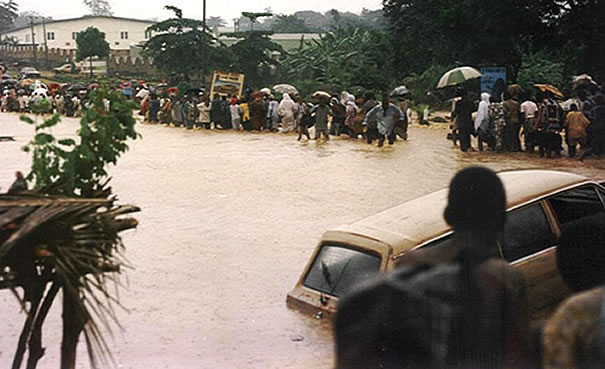
As the impacts of global change in climatic conditions continues to reverberate in the forms of rising temperatures and sea levels, leaving behind its trail disasters in the forms of floods, desertification and other environmental degradation, Nigerians are becoming more aware of the realities caused by global warming. Lagos state has seen greater rainfall and on 13th February experienced very heavy wind which caused lots of damage to public and private property. Severe drought is being felt in Kaduna state and other parts of Africa plus the evacuation of the Kiribati Island is now eminent.

Europe continues to battle a deep freeze that has killed hundreds of people, with transport and navigation services badly hit across the continent cutting off tens of thousands of people. Thick ice has closed hundreds of kilometres of the Danube river in half-a-dozen countries and confined scores of ships to port on the busiest European waterway.  The 2,860km-river, which flows through nine countries and is vital for transport, power, irrigation, industry and fishing, was wholly or partially blocked from Austria to its mouth on the Black sea.

Britain is also expecting heavy snow, up to eight centimetres, while flooding in Greece has left dozens of homes under water after the Evros River burst its banks. Meanwhile, Italy braced for another wave of freezing weather, even as soldiers worked to free villages trapped in three metres of snow and with the death toll from the cold snap already at 43. Local authorities in Rome have begun distributing 4,000 spades for local residents. They have boosted the city's stocks of salt to 1,000 tons and have dozens of snow ploughs at the ready.

From Jekwu Ikeme's article on the subject, the social implication of climate change for Nigeria is multidimensional. In the first instance, projections suggest that Nigeria will experience massive "environmental refugee" migration. For a 1-m rise, more than 3 million people are at risk, based on the present population. The estimated number of people that would be displaced ranges from 740,000 for a 0.2-m rise to 3.7 million for a 1-m rise and 10 million for a 2-m rise (Awosika et al., 1992). The most vulnerable is the coastal region of the country. A large percentage of Nigeria's urban population live in coastal cities. Estimates put the total population living along the coastal zone to about 20 million people which translates into 22.6% of the national population. Similarly, most of the economic activities that form the backbone of the national economies are located within the coastal zone. Coastal areas also form the food basket of the region. Offshore and inshore areas, as well as estuaries and lagoons, support industrial fisheries accounting for more than 75% of fishery landings in the region. This naturally dovetails into the second social implication of climate change which is that of its effect on food security. As populations are displaced and climatic and vegetational belts migrate away from the traditional geographical location, a general disruption in food production is expected to be the outcome.

Environmentally, Nigeria's climatic regime stands to be severely disrupted leaving its forests and water resources at risk.. Studies show that biological productivity in Nigeria will decrease in the event of global warming (Adesina and Adejuwom, 1994) with an additional consequence of severe fuelwood shortages. Already Nigeria has experienced definite shift in the long-term rainfall mean towards more arid conditions. These climatic changes have had adverse implications for water resources availability for power generation and agriculture. Likewise, Nigeria's low-lying lagoonal coasts stand threatened by sea-level rise, particularly because most of its major and rapidly expanding cities are on the coast. If sea level rises, inundation could occur along more than 70% of the Nigerian coastline, placing land at risk many kilometres inland (Awosika et al., 1992). In Nigeria, inundation is the primary threat for at least 96% of the land at risk (Awosika et al., 1992; French et al., 1995). With a 1-m rise in sea level, up to 600 km2 of land would be at risk. This area includes parts of Lagos and other smaller towns along the coast. The periodic overflow of the Atlantic across the Bar beach bank is an indication of a phenomenon that may accelerate as climate change intensifies and the seal level rise even further.

In Nigeria today, some state governments in collaboration with the Federal government have begun taking steps to mitigate the effects of global warming in Nigeria, however it is my opinion that members of the public need to be more aware of this problem and start finding solutions within ourselves. The government needs to largely educate Nigerians on what we are to expect in the coming months and how best to safeguard our lives and properties.

Adedunmade Onibokun Esq.